We ship worldwide…


10 Essential Factors for High-Performance Facial Recognition Systems


10 Essential Factors for High-Performance Facial Recognition Systems
Facial recognition technology has become a common tool of everyday use from a concept of the future. It is influencing the way we utilize services and technology. But not all systems work at the same level. A high performance facial recognition system needs to combine accuracy and speed with fairness and security, not just basic identification. Real world conditions like poor lighting and heavy user traffic test these systems everyday. The most effective systems are those that are designed to adapt and protect user trust while minimizing errors.
In this blog, we will explain ten essential factors that separate high performing systems from the rest. No matter if it’s for personal use or business application, understanding these elements is key to deploying the best facial recognition technology.

1. Image Quality and Preprocessing
The camera quality is an important aspect of accurate facial capture. Bad lighting, blurry pictures, and covered faces all affect results. People with different physical features and accessibility needs can get clear, dependable results from facial recognition cameras that operate best in a vertical field of view.
Top systems use preprocessing methods like face alignment, normalization, and noise reduction. These steps prepare the image so that even photos from security cameras or mobile devices can be used effectively, giving the system the best chance to work well.
2. Algorithm Accuracy
The “brain” of facial recognition is its algorithm. While deep learning models like convolutional neural networks and vision transformers are now widely used, earlier methods depended on manual features.
Accuracy is often measured on datasets like LFW or MegaFace. But great results in a lab don’t always mean success in real-world use. High-performing systems focus on reliable accuracy across different lighting, skin tones, and age groups , not just on test scores.


3. Speed and Scalability
Recognition isn’t only about being correct; it also has to be fast. Airports or payment systems need results in seconds, even when millions of comparisons are happening at once.
Scalability is just as important. The system should work for small uses, like unlocking a phone, as well as large-scale projects like national ID programs. Optimized software, GPU use, and distributed computing help achieve this balance.
4. Robustness to Variability
People’s faces change all the time, with age, beards, makeup, and glasses. External factors like poor camera quality and bad weather add to the challenge.
Strong systems are built to handle these changes. They use advanced feature extraction and adaptive models that can still recognize a person despite variations. Some even track changes over time to improve long-term recognition.


5. Bias Mitigation and Fairness
A big issue with facial recognition is matching bias. Studies show some systems work better on lighter-skinned men but worse on darker-skinned women.
A truly high performing system must be fair. That means training with diverse data, using fairness-focused algorithms, and auditing results regularly. The goal is accuracy that works for everyone, not just a majority group. This approach is more efficient and saves effort.
6. Security Against Spoofing
Photos, videos, and masks can all fool facial recognition. Without protections, this creates big security risks.
Leading systems use liveness detection, methods like blink tracking, texture checks, depth sensing, or infrared scans. These confirm the subject is a real person, not a fake image, which is especially important for banks and border security.


7. Integration with Other Modalities
No biometric method should stand alone. High quality facial recognition works best when combined with other tools like fingerprints and voice recognition.
This multi-layer approach boosts reliability. For example, if a face is hidden, a fingerprint can act as backup. Good systems are designed to integrate smoothly with other identifiers without slowing down performance.
8. Data and Privacy Protection
Privacy concerns are growing with more use of facial recognition. Storing face data can raise risks of surveillance or hacking.
High-performing systems follow privacy by design principles. This includes encrypting templates, and storing it for as long as necessary. They also follow regulations such as the CCPA and GDPR. Systems that respect user rights build more trust.


9. Adaptability Across Environments
Facial recognition systems work in very different places, dark subway stations, crowded arenas, and bright offices. Performance must remain consistent.
Advanced solutions use adaptive settings to adjust performance based on context. Some also support edge computing, letting recognition happen directly on devices to cut delays. The system can be used in both controlled and dynamically changing environments because of its adaptability.
10. Regular Learning and Improvement
Threats change along with people and circumstances. Systems that don’t evolve will fall behind.
Continuous updates are a feature of the best facial recognition systems. They retrain models with new data, adjust to user feedback, and improve security features like spoof detection. This constant learning keeps them effective over time.

Real-World Applications of High-Performance Systems
-
1.Smartphones & Devices:
Fast, secure unlocking with liveness checks.
-
2. Airports & Borders:
Large-scale, speedy verification for diverse travelers.
-
3. Banking & Payments:
Fraud-proof authentication paired with other biometrics.
-
4. Public Safety:
Reliable recognition balanced with ethical oversight.
These examples show how the ten factors connect. Airports focus on scalability, speed, and fairness, while consumer devices value privacy and spoof protection most.
Challenges Ahead
Even with strong systems, challenges remain. Ethical debates around consent and surveillance continue.Laws sometimes can’t keep up with technology. Public trust is also fragile.
The future of facial recognition should be on solving these social issues not only on better performance. The next generation of this technology will be guided by transparency, accountability and fairness.

Frequently Asked Questions
Q: What is the best algorithm for facial recognition?
Ans: The best algorithm for facial recognition is Convolutional Neural Networks (CNNs) because of their ability to extract high picture quality. The best models are FaceNet and ArcFace, delivering high accuracy in facial recognition tasks.
Q: Which AI is used for facial recognition?
Ans: Modern systems mostly use deep learning based computer vision AI, mainly using CNN architectures to extract and match facial features.
Q: How to improve face recognition accuracy?
Ans: High-quality, well-lit training photos, data augmentation, and advanced algorithms like ArcFace for feature embedding all help to increase accuracy.
Q: What part of the brain affects facial recognition?
Ans: The fusiform gyrus, the fusiform face area (FFA) located in the inferior temporal cortex, plays a key role in processing and recognizing human faces.
Conclusion
Biometrics are the greatest investment in home security. With the promise of easy access and clever protection, they provide futuristic convenience today. Still, like all technologies, they demand careful consideration. Are they the smart choice? Yes, according to many homeowners, as long as systems are carefully selected, privacy protections are upheld, and there are still several access choices. The most intelligent security ultimately combines the inventiveness of biometrics with the dependability of conventional techniques to create a secure environment that changes with the times.
 WiFi Camera
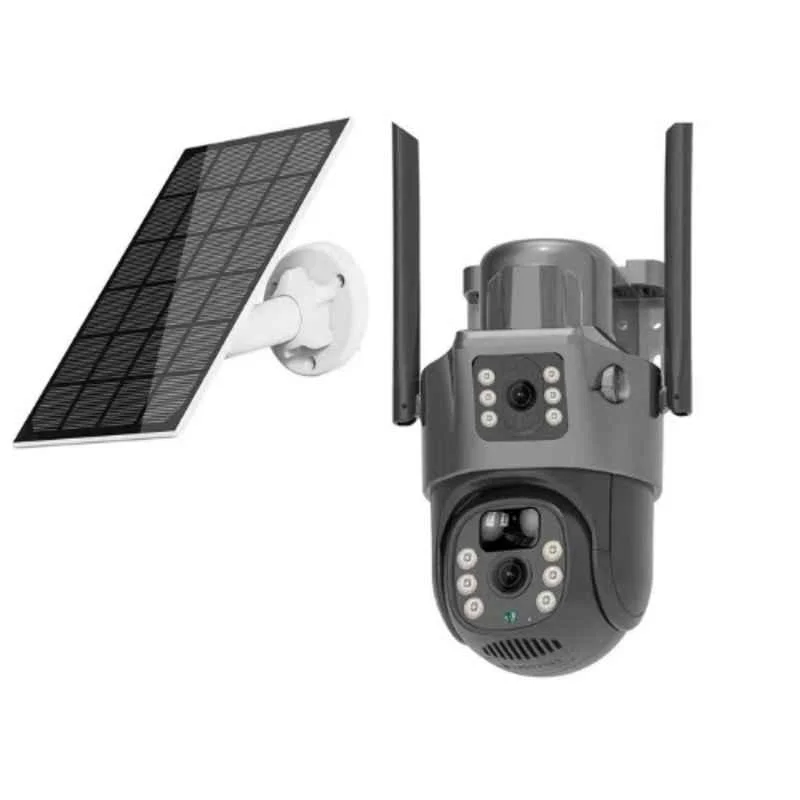 Solar Camera